
Aachen, March 2026: Automated driving functions are only as reliable as their sensor technology. In addition to radar and camera systems, LiDAR sensors can be used. LiDAR (Light Detection and Ranging) systems use laser pulses to generate high-resolution three-dimensional images of the vehicle's surroundings. They measure distances, detect objects and provide so-called point clouds, which can be used for functions such as lane guidance, obstacle detection and automated driving manoeuvres.
In practice, however, these systems do not operate under laboratory conditions. Rain, fog, snow, dust or dirt on the sensor cover can significantly affect signal quality. At the same time, there have been no uniformly harmonised test procedures to date for objectively and comparably evaluating the performance of different LiDAR systems under such adverse conditions. Manufacturers, suppliers and testing organisations sometimes used their own methods, which limited the comparability of the results.
Development of a standardised test methodology
Against this backdrop, the industry consortium LPAC (LiDAR Performance in Adverse Conditions) was launched in October 2023 under the leadership of fka GmbH. The aim was to develop a reproducible and manufacturer-independent test methodology for evaluating the performance of LiDAR sensors under non-ideal environmental conditions.
Twelve companies from the automotive industry joined the consortium, including OEMs, Tier 1 suppliers, LiDAR manufacturers, component suppliers and testing organisations.
‘Higher automation levels must work reliably even when conditions are far from ideal,’ explains Prof. Dr.-Ing. Adrian Zlocki, Head of Automated Driving at fka GmbH. ‘With DIN SAE SPEC 91571, we are creating the first reproducible and manufacturer-independent basis for objectively evaluating the performance of LiDAR sensors under realistic environmental conditions. This not only increases the comparability between systems, but also strengthens trust, transparency and safety in the development of automated vehicles in the long term.’
The method development focused on three key influencing factors:
- Weather conditions such as rain or fog
- Contamination of the sensor surface by dust, dirt or road spray
- Interference from other LiDAR systems or optical sensors
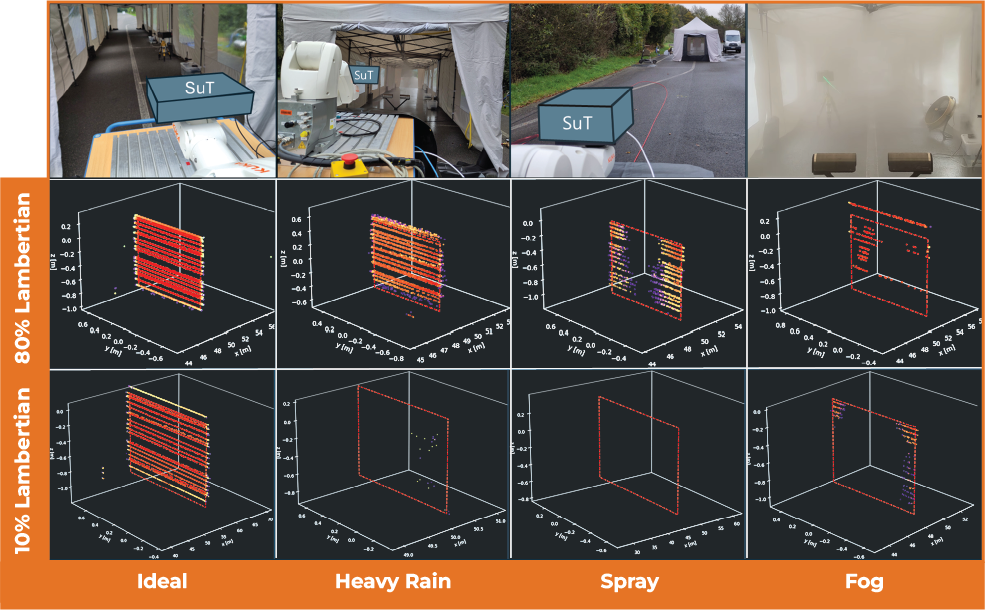
Additionally, a methodology for evaluation of sensor cleaning performance using sensor data was defined.
The test methodology, the necessary test tools and defined scenarios were developed and validated as part of the project. Eight different LiDAR sensors were tested on a test track in Aachen – with wavelengths of 905 nm and 1550 nm and different measuring principles such as time-of-flight (ToF), which measures the time differences between laser pulses, and Frequency Modulated Continuous Wave (FMCW), which additionally determines speed information via frequency shifts.
Temporary rain, fog and spray chambers were used under realistic conditions. In addition, systematic interference tests were carried out with several LiDAR systems operating simultaneously.
Publication of DIN SAE SPEC 91571
Based on the results of the LPAC consortium, DIN SAE SPEC 91571 was published in March 2026 by the German Institute for Standardisation (DIN) and the Society of Automotive Engineers (SAE).
The specification defines a uniform evaluation methodology for LiDAR sensors – regardless of sensor design, technical configuration or measurement principle. It enables structured performance evaluation at both the point cloud and object levels under defined adverse conditions.
This new framework particularly benefits:
- Vehicle manufacturers
- Sensor and component suppliers
- Development and research institutions
- Hardware and software developers
- Testing organisations and test site operators
- Manufacturers of ADAS and automated driving functions
‘The challenge was to map environmental influences such as precipitation, aerosols, pollution and optical interference not only qualitatively, but also in a way that is reproducible in terms of measurement technology,’ explains Amogh Sakpal, project manager of the LPAC consortium at fka GmbH. "With DIN SAE 91571, we define clearly structured test procedures, evaluation metrics at point cloud and object level, and standardised boundary conditions. This makes it possible to compare the performance of different LiDAR technologies – regardless of wavelength or measurement principle – under identical conditions. This is an essential prerequisite for reliable development decisions and the industrial scaling of automated driving functions."
The DIN SAE specification 91571 is now available here.
Using its expertise in both the DIN SAE Specifications 91471 and 91571, fka offers a wide portfolio of tests for complete functional evaluation of LiDAR sensors. fka expresses sincere gratitude to all the partners of the LPAC consortium and DIN SAE SPEC 91571 test framework for all their contributions towards the creation of this specification.
Members of the LPAC consortium
fka GmbH, CHASM Advanced Materials, Daikin Chemical Europe, DEKRA Automobil Honda R&D Europe Kautex Textron, MicroVision, Scantinel Photonics, TORC Robotics, Valeo Volvo Cars
About fka
For 40 years, fka has been internationally known as an innovative engineering service for the mobility industry. Driving the world by developing ideas and creating innovations is the mission statement that fka's 160-strong team is committed to.
The team is inspired by a passion for efficient, safe and fascinating mobility. As one of the first companies on the Aachen campus, the spin-off of the Institute for Automotive Engineering of the RWTH Aachen University demonstrated entrepreneurial foresight.
Interdisciplinary expertise in all aspects of mobility and technological visions, combined with the advantages of the inspiringly creative location, are fka's fuel. Ideas, innovations and unique methodological expertise are shaped into well-founded and secured solutions that give fka's customers the necessary edge in a wide range of issues.
A complete spectrum of services, ranging from consulting and conception to simulation and design, prototype construction and experimental testing, forms the basis for this.
With the credo "creating ideas & driving innovations", the team constantly has the mobility of the future in mind.
Released for publication. If reprinted, please send us a copy. If you have any questions or would like to receive further material, please contact:
Julian Refghi
Head of Marketing & Communication
Telefon +49 241 8861 227
E-Mail: This email address is being protected from spambots. You need JavaScript enabled to view it.
Ihr Ansprechpartner
Your Contact
![[Foto: Julian Refghi M.Sc.]](/images/personen/refghi-julian.jpg)
Julian Refghi M.Sc.
Head of Marketing & Communication
This email address is being protected from spambots. You need JavaScript enabled to view it.
Telefon: +49 241 8861 227
This email address is being protected from spambots. You need JavaScript enabled to view it.
Phone: +49 241 8861 227